
Comparison between flame galvanizing and electric arc
Spray metallization represents a highly effective solution for the anti-corrosion protection of metal surfaces. Among the main technologies used, la spruzzatura ad arco elettrico offre prestazioni superiori rispetto alla spruzzatura a fiamma sotto il profilo dell’aderenza, productivity and coating quality.
Why choose the electric arc
In an aluminum coating obtained with the electric arc, adhesion is up to 2,5 times greater compared to that obtained with flame spraying. This translates into better sealing of the coating and greater reliability over time, even in particularly aggressive environments.
Electric arc spraying
More advanced technology, ideal for applications requiring high deposit quality, better mechanical performance, faster operating speed and a more uniform finish.
Flame Spraying
Traditional solution still used in certain contexts, but generally less performing in terms of adhesion, coating density and productivity compared to the electric arc.
Other advantages of the electric arc are: greater efficiency of the deposit, ease of work, greater safety for the operator, faster switching on and off, less maintenance, better hourly productivity, reduction in operating costs, better surface appearance of the coating and greater ease of automation.
Technical comparison
| Technology | Temperature °C | Particle speed m/s | Breaking load MPa | Porosity (V%) |
|---|---|---|---|---|
| Electric arc | 4000 | 100 | 10–15 | 10 |
| Fiamma in gas | 3000 | 40 | 10 | 10–15 |
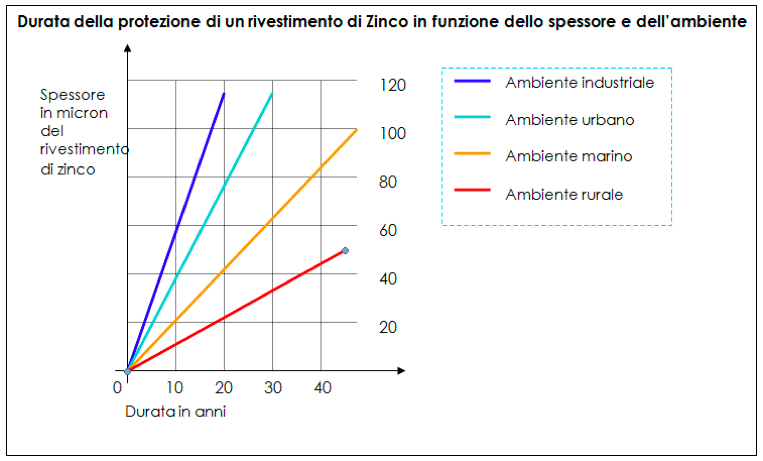
Duration of protection and average thicknesses
The duration of the anti-corrosion protection depends on the operating environment and the thickness of the coating applied. The following data shows, indicatively, the relationship between average duration of treatment, type of protection and average thickness in microns.
| Average length of years | Typology | Average thickness micron |
|---|---|---|
| > 20 | Al Spruzzatura (ISO 2063) | 150 |
| > 20 | Spruzzatura Zn (ISO 2063) | 250 |
| 10 < 20 | Spruzzatura Zn | 150 |
| 10 < 20 | Zincatura a caldo | 150–200 |
| 5 < 10 | Zincatura a caldo | 175 |
| < 5 | Zincatura a caldo (ISO 1461) | 70–85 |
Summary of benefits
- Greater adhesion of the coating compared to flame spraying.
- Better compactness and less porosity of the deposit.
- High productivity and reduction of operating costs.
- Better surface finish and ease of automation.
- Long-lasting protection even in aggressive marine and industrial environments.